
Friday service design blog

Welcome to the Reykjavík service design Friday blog! Over
the coming weeks, we'll take a deep dive into services and digital solutions for older adults in Reykjavík. First on our agenda is looking at home support and exploring how we can make services better for residents and their immediate family. We will share project updates with you every Friday for the duration of the project.
From home care services to primary schools
One of the best aspects of service design is the sheer variety of topics it covers. Recently, alongside our analysis of home care services, we have also been working on a project with the Department of Education & Youth.
To mark the occasion, the service design team is kicking off a new project: A needs assessment for a student and learning management system for the City's primary schools! So we are moving straight from home care services into the classroom.

Reykjavík City operates 38 primary schools, and every one of them uses some type of system to manage student records, learning, and home-school communication. The Department of Education & Youth is now preparing to put the system out to tender. Before defining what a future solution must do, we need to understand the needs of the many people who use these systems. That is why a needs assessment is a key part of preparing the tender—we use it to:
- gain insight into how people use the current systems and how they feel about them
- observe, ask questions, and learn
so we can build an accurate picture of what people actually need from these systems.
We got off to a strong start with a workshop where we defined the project scope and mapped out the stakeholders. It quickly became clear that we would need to look at this from many angles and speak with a wide range of stakeholders—from teachers and parents to the Center for Education and School Support Services, Statistics Iceland, the Icelandic Data Protection Authority, and The Icelandic Disability Alliance.
Our first step was to get an overview: familiarizing ourselves with the schools' tasks and processes, examining how people use current systems, and mapping out the different groups of service users. It turned out to be a real advantage that most schools designate a specialist and liaison for the system they use—typically a teacher or another staff member. This person knows the system well, has often completed additional training, and is the go-to resource when others need help. As a result, they have a solid understanding of:
- Who uses the systems
- How people use them
- What challenges tend to arise
We invited these specialists to workshops to map out these points with us, and the response was fantastic. More than 50 people took part in one of the two workshops, and they had plenty to share. We'll share more on that, as well as our deeper conversations, next week.
How do we design access to services when demand outstrips capacity?
May 29, 2026
Prototyping and ongoing analysis of the home support project took center stage this week.
We have been hard at work developing the initial version of a new application flow. Our goal is to make the application more intuitive for service users while providing staff with better information earlier in the process. Simultaneously, we have been exploring ways to improve the information provided to service users and their immediate family before they submit an application.
Interestingly, our research over the past few weeks is steering us beyond the application itself.
Conversations with home support team leaders revealed that the application form itself is not the primary challenge. Every application undergoes the exact same process, regardless of the specific service need. Team leaders conduct home visits, cases are reviewed in assessment meetings, and applicants either begin receiving services or join a waitlist. For certain groups, these waitlists can be exceptionally long.
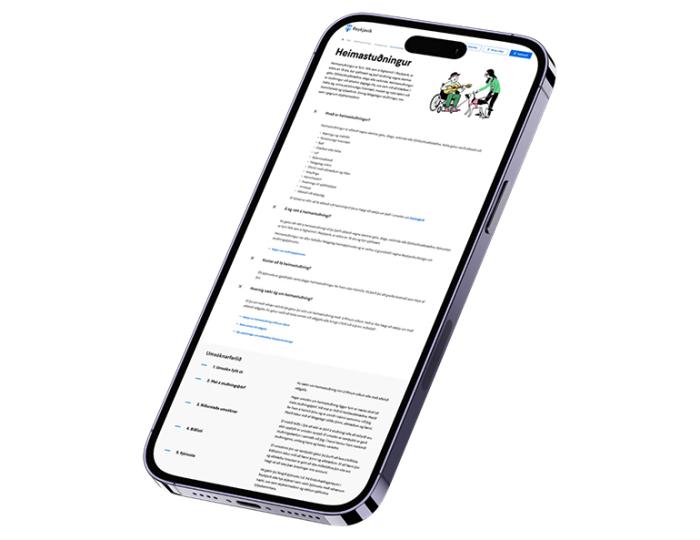
Is the project really about improving the application process?
Or have we begun examining how access to services functions when demand outpaces capacity?
This week, I dove deeper into the support program regulations, examined the evolution of these services, and explored how we can better support both service users and staff without reducing access.
You may be eligible for home support if you need assistance due to reduced ability, stress, illness or family circumstances. "Services are available to individuals who have legal residence in Reykjavík, are over 18, and live independently." — from the home support regulations.
- Challenge 1: The services are "too open," resulting in a high volume of applications.
- Challenge 2: The regulations are intentionally broad to accommodate the wide-ranging purpose of the services.
What opportunities exist without changing the regulations?
1. Separating service pathways:
Nothing in the regulations requires that:
- all cases follow the same process
- all cases require the same visit
- all cases
require
the same handling
2. This opens the door to separate applications and differentiated processes for visits and prioritization.
Much stronger communication of information
- We could go much further in:
- managing expectations
- helping people assess their own situation
- preparing people for wait times
- what the services
do
and do not cover
3. how the assessment process works
without making any legal changes. Designing the waitlist We must design the waitlist as an integrated part of the services — which it currently is not. The regulations require that
individuals
be informed of their status and estimated wait time.
The regulations also explicitly provide for reassessment when circumstances change — which creates significant duplication of effort when someone remains on a waitlist for over a year.
It is also vital to examine support during the wait period, connections to other resources, welfare technology, and more.
We have also mapped the technical landscape — identifying which systems
are involved in the current process, what data moves between them, and where opportunities for simplification exist.Our next steps include a workshop focused on service design, followed by a prototype presentation to the project's ownership group, where we will work through these larger questions together. Warmly, Service design 💛
Better flow, better services
May 22, 2026
After a few weeks away from the blog, it feels great to be back. We spent most of the past few weeks finalizing and delivering the diagnosis to the project owners.
The diagnosis covered the current home support process, detailing how applications are received and handled, as well as the overall experience for both service users and staff.
We identified six core challenges. Simply put, information flow is fragmented in both directions, and the current process requires a substantial amount of manual work.
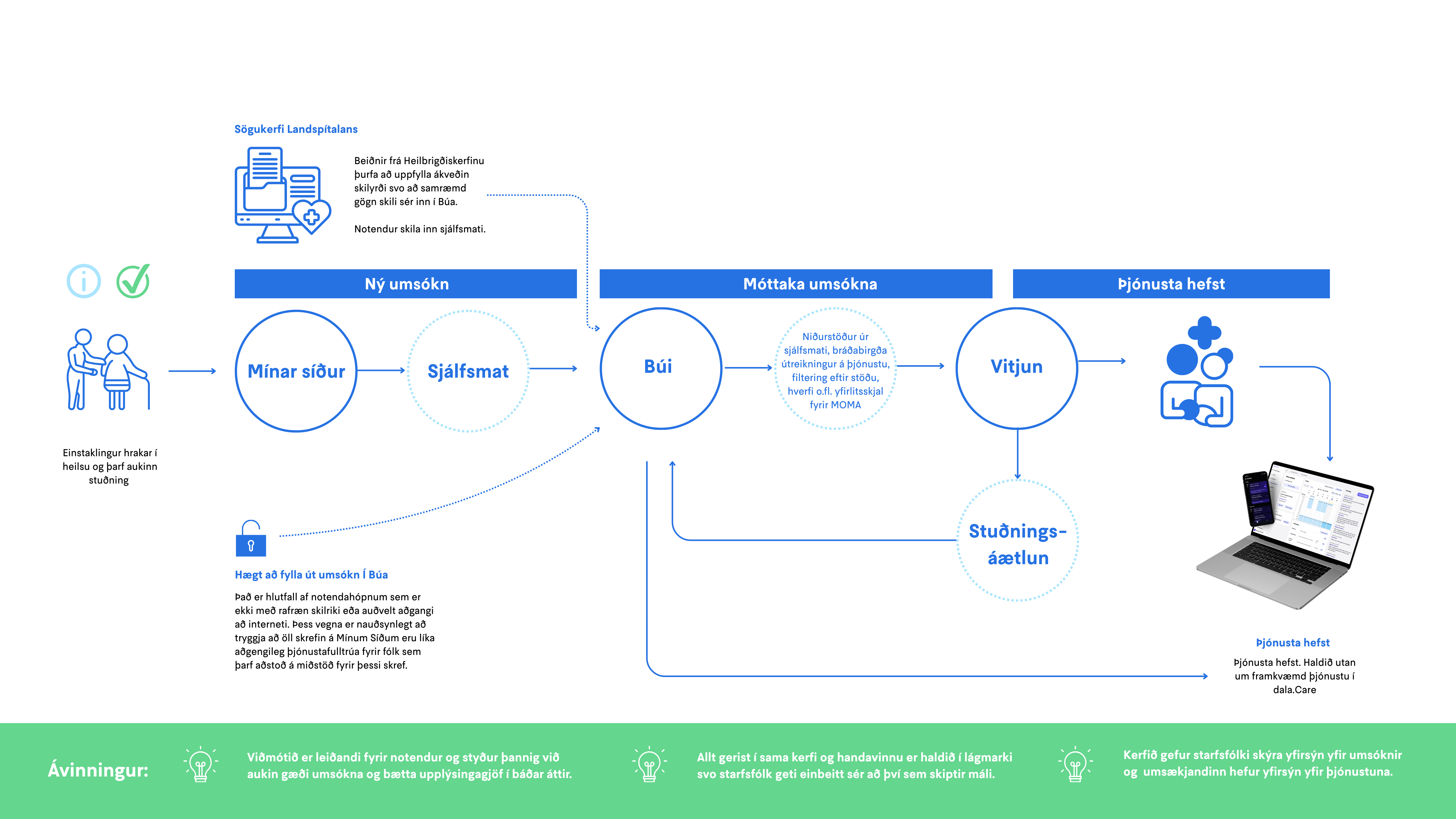
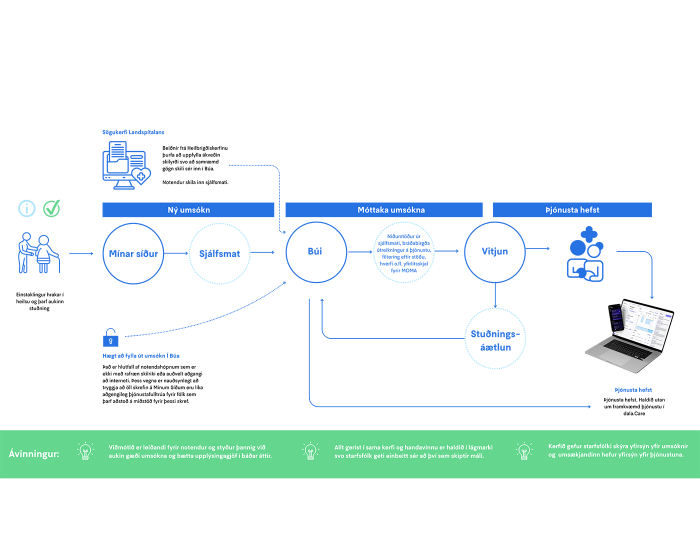
Prototype in progress
Simultaneously, we have been collaborating with a digital product designer to develop a prototype for the service process. This process spans everything from the initial receipt of an application to the moment services begin. We are exploring ways to present staff with the right information at the right time, making decision-making more focused and daily work more efficient.
This work has two primary goals:
- To improve the service user experience through clearer, more accessible services
- To simplify daily routines and better support staff in their work
We are also exploring ways to improve information delivery for both service users and staff. Our focus is on cutting through unnecessary noise and ensuring details are useful and readily accessible when needed.
This week, we held numerous conversations with service staff and conducted user interviews with home support team leaders. The objective was to determine which facts matter most for decision-making and identify what staff currently lack to work safely and efficiently. During these sessions, we covered:
- which details matter most in applications
- what information is currently missing
- how applications are assessed
- how data supports service allocation
- and what would make the workflow more efficient and secure
"I'm team self-assessment"
"I'm team self-assessment!" is a direct quote from a home support team leader when asked this week about her ideal process.
Building on that feedback, we started exploring how self-assessment could work in practice and how best to roll it out from both a technical and service user experience perspective. The solution must accommodate diverse groups and fit naturally into the overall workflow. Self-assessment empowers service users to articulate their needs more clearly while providing staff with a stronger baseline, eliminating the need to start from scratch at every visit.
Is this all digital?
One of the most crucial considerations in this project is the service user demographic, which consists primarily of older adults. Many individuals find digital interfaces difficult to navigate, lack reliable internet access, or simply need assistance filling out applications.
It is essential to remember that digitalization presents an opportunity, but it is not a standalone solution. Throughout this digital transformation, we must remain vigilant to avoid losing sight of the human element. Our goal is not to replace personal service, but to strengthen it. In fact, better digital solutions can free up more time for meaningful, personal service where it matters most.
We look forward to sharing the prototype with you soon!
Hugs, your friends at Service Design 💛
First diagnosis findings emerging
April 17, 2026
Friday at last! It's been a busy but exciting week for the service design team. We're wrapping up the first phase of the diagnosis work; this week focused on compiling user interviews, identifying themes, and drawing out patterns.
We've had informative conversations with staff and are reviewing recommendations from the Department of Welfare's improvement team. They've already done impressive work, and we want our project to build on those efforts.
Discussions are also ongoing regarding the technical future of this service area. Will it live on Reykjavík's My Pages, for example, or on Ísland.is? Which system is the best fit for this service area? Alongside the diagnosis work, we're busy mapping out these possible scenarios.
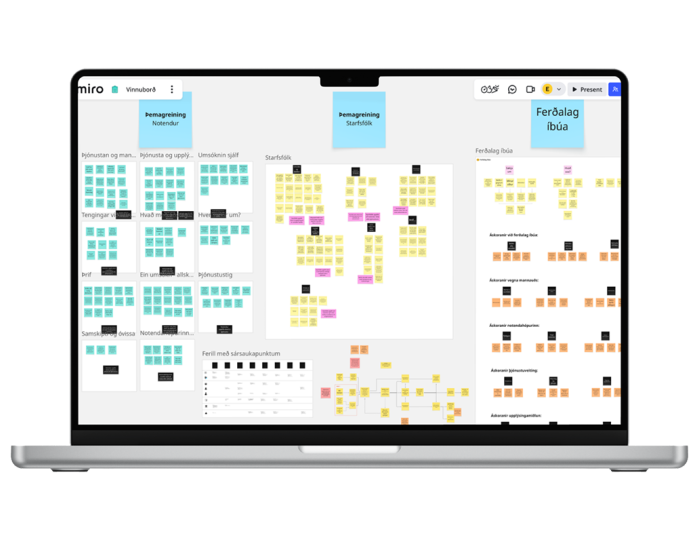
Needs and challenges
Curious about what we've found so far? What do home support service users and staff actually think about the service? We'd like to share a few highlights from the diagnosis work.
Key insights
1. Understanding the service
Service users lack a clear picture of what the service involves, and staff spend significant time explaining it. There's no shared picture of the service available to people before they make contact.
2. Expectations vs. reality
Service users feel the service lacks flexibility and misses their needs, while staff find that expectations often exceed what the service can deliver. Expectations aren't aligned early enough in the process.
3. Access to information
Service users struggle to find necessary information, and staff often handle applications containing incomplete data. The flow of information is fragmented in both directions.
4. Complexity and inconsistency in processes
Service users feel the process lacks continuity and clarity, while staff experience inconsistency in intake and procedures. The overall experience doesn't feel like a single, coherent process.
5. The role of immediate family
Immediate family members feel left out of the system despite expectations to be involved in everything, and staff spend considerable time communicating with them. The role of immediate family is unclear and not formally supported within the service.
6. "Checklist" vs. diverse needs
Service users feel a one-size-fits-all process doesn't work for everyone, while staff navigate unclear or inconsistent standards. The service needs a framework that is both clear and flexible.
How might we…?
So what do we do with these insights? The first step is turning them into opportunities. We do that by using "How might we?" questions to reframe challenges as opportunities. This approach encourages creative solutions by focusing on service users' needs and experiences.
What makes a good HMW question?
- Start with the problem we've identified
- Resist jumping straight to a solution
- Keep the questions broad — but not too broad
- Frame the questions positively
Here's what those questions might look like:
- How might we build a shared understanding of the service before it begins?
- How might we align service users' expectations with what the service actually provides?
- How might we simplify the process and give both service users and staff a clearer picture of what's happening?
- How might we better define and support the role of immediate family members?
We're carrying these questions into our ideation work and can't wait to share more with you!
W
armly,your friends in service design 💛
Turning challenges into opportunities
April 10, 2026
The response to our Friday blog has been truly wonderful to see. We hardly dared hope so many people would follow along, but there's a real appetite for a behind-the-scenes look at work in progress.
That's what keeps us going. Over the coming weeks and months, we plan to share more projects with you. Stay tuned!
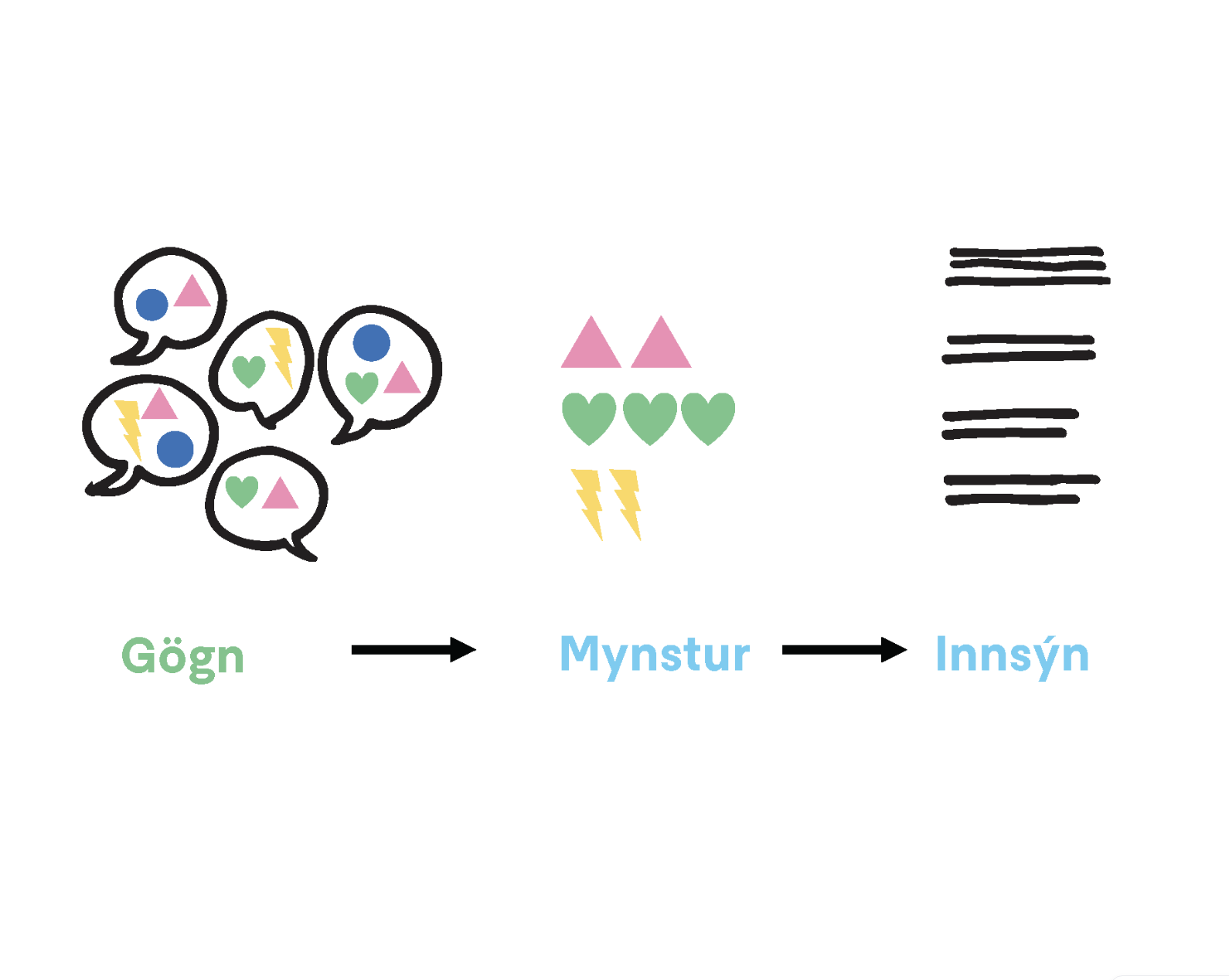
Growth Lab — for those who want to try it themselves
For those eager to dive deeper, remember that Growth Lab starts up again next fall. Growth Lab is a program open to all City staff who want to explore service design and apply its methods to their own projects.
We'll announce upcoming dates soon. In the meantime, you can read more about Growth Lab.
Home support — two sides of the same story
"It's all become fairly straightforward these days. People should just be able to go online and handle it themselves."
"I honestly didn't know where to turn, so I just asked someone who knew someone."
Over the past few weeks, we've talked extensively with both service users and staff in home support. We heard these two remarks in separate conversations. One came from a staff member who knows the service inside and out. The other came from a service user navigating the process for the very first time.
Neither of them is wrong. But between those two perspectives lies a gap we need to understand better. And that's exactly where things get interesting. Where something that "should work" doesn't quite work the way we assumed it would.
These conversations surfaced various small details ripe for improvement. Things we assumed were clear don't always land that way for people. At the same time, a lot of good work is already underway. The staff we've spoken with don't just deliver day-to-day services — they actively work to improve them. We've seen a clear drive for change, fresh approaches, and projects already making a difference.
That work isn't always visible, but it matters enormously. And it makes this exactly the right moment to focus on the service. While we analyze and draw out insights, changes are also taking shape within the service itself. That means we're stepping in when real opportunities exist to make an impact.
Outside the system, inside everything
Alongside the interviews, we're making sense of what we've learned — identifying themes, spotting patterns, and pinpointing pain points. It's important to treat all these insights as opportunities rather than problems. They're chances to simplify and improve the experience for everyone involved.
One theme has already emerged clearly:
Immediate family members play a much larger role in the service than the system accounts for.
Time and again, we see immediate family members seeking information, following up on cases, and supporting their loved ones. In practice, they are key service users — yet the service wasn't designed with them in mind.
This raises an important question:
How can we better support immediate family members without placing even more responsibility on their shoulders?
We're looking forward to digging deeper into that opportunity.
Thank you for following along on this journey.
Your friends in service design 💛
Do you know what you don't know?
March 27, 2026
This week, we dove deeper into the project to better understand the Welfare Division's extensive work. Staff members walked us through areas requiring more clarity, including Home Support's operating procedures, upcoming service changes, and practical details crucial to our next steps.
The week didn't go entirely as planned, however—our scheduled interviews and meetings with older Reykjavík residents fell through. While yesterday's weather was partly to blame, we shifted gears on Wednesday to attend the Association of Local Authorities in Iceland's digital conference, where service design team lead Andri presented on the vital need to speak directly with users.
He delivered a compelling talk, emphasizing the value of staying human, engaging the people who actually rely on these services, and recognizing the limits of our own knowledge. That aligns perfectly with the message we aim to share through this blog!
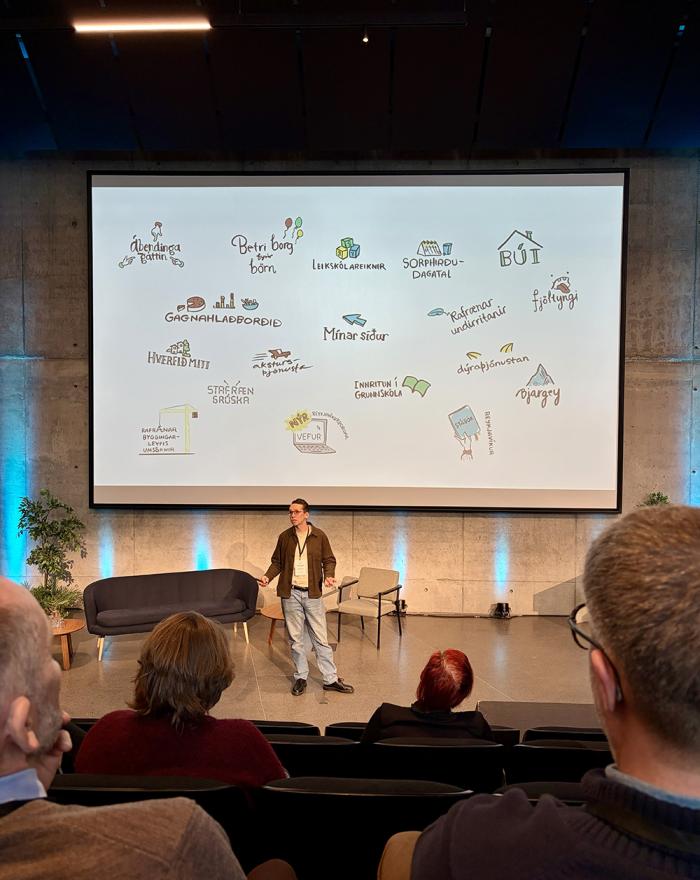
When the weather puts a stop to things…
…we find other opportunities. We spent yesterday reviewing our collected data and starting our initial round of thematic analysis. We looked for patterns, noted emerging questions, and identified areas requiring further research.
What does starting a thematic analysis actually entail?
The goal is to:
-
Define users' core needs
-
Turn challenges into opportunities
-
Find focus
We achieve this by "re-listening" to our data. What does that mean in practice?
Think of it this way—we divide the process into three phases:
-
What do we need to know? We tackle this through user interviews, conversations with staff and specialists, and our broader research over the past few weeks. This yields our data: what people say and what they do.
-
What does it mean? We answer this through thematic analysis, searching for patterns in behavior and thought. This provides insight and builds a clearer picture of actual user needs.
-
What are we going to do? We approach this by translating our new insights into actionable opportunities. What can we accomplish, and how does that shape the project? From there, we can prioritize based on potential impact.
People often rush to prioritize, but working through every step is essential to truly understand what the data reveals. We might be specialists, but we cannot predetermine genuine user needs. Or, as Andri noted in his presentation: we don't know what we don't know.
Example:
❌ Jónía said she wanted a website, so we will build a website
✅ Most users, like Jónína, lack clarity and need to know the next step toward their goal
Ultimately, we aim to find patterns in our data and define what they mean and why they matter.
We also use various tools to support this ongoing definition phase, including affinity maps, archetypes, and user journey maps. We will share more about those techniques later. All of this lives in our toolkit, which you can access here!
We will be off next Friday for Good Friday, but we look forward to resuming our work after Easter!
Your friends in service design 💛
Let's be human!
March 20, 2026
Let me introduce you to Guðrún. Guðrún is an 87-year-old woman who lives alone. Her husband, Hafsteinn, passed away eight years ago. Guðrún and Hafsteinn have one daughter, Eydís, who is 55. Eydís works as a head of division at a local company and has three sons of her own, aged from 11 to 19.
Guðrún has always been healthy, active, and sociable—apart from back pain she has endured since a car accident when Eydís was a child.
She has attended physical therapy ever since, which largely keeps the pain under control. In recent years, however, her body has started showing its age.
Guðrún has always kept a warm, welcoming home, and that remains just as vital to her today.

One thing leads to another...
With visitors expected over the weekend, Guðrún spends Thursday morning vacuuming and cleaning her house. The exertion leaves her exhausted and aching.
She lacks the energy to visit the store or cook a proper dinner. Still hurting and underfed, she sleeps poorly that night. After such a rough night, she feels too unwell to attend her Friday morning physical therapy appointment.
Skipping physical therapy takes its toll as the day progresses and her back pain worsens—but Guðrún, always a gracious host, pushes through to bake a cake for Saturday's gathering. Aching and running on fumes, she feels entirely drained after baking and manages only another light dinner. Once again, she tosses and turns through the night.
Saturday arrives, with guests expected that afternoon. She feels exhausted, in pain, and far from her best. Calling her daughter Eydís to cancel the gathering, she explains she simply doesn't feel well enough. Guðrún stays inside and misses seeing her family over the weekend. Beyond the physical pain, she feels disappointed and isolated.
Now let's fast-forward. Guðrún has applied for home support services from the City. Once again, she invites people over for Saturday. It's Thursday. Monika, a home support worker, arrives at noon. They sit together at the kitchen table to discuss Guðrún's upcoming plans.
Guðrún mentions expecting weekend guests and wanting the house to look nice. She also notes her plan to bake a cake. Today's visit is scheduled as a social check-in, and Guðrún isn't due for a cleaning until next week. Even so, Monika suggests they tidy up slightly together; she tackles the floors while Guðrún handles some light dusting.
As they work, they chat about their shared love for an ongoing handball tournament and the Icelandic team's performance. Afterward, Monika sits down to help Guðrún draft a shopping list, noticing she only jotted down ingredients for a pavlova without considering dinner.
Monika's shift is nearly over, but before leaving, she offers to help Guðrún order grocery delivery through the Króna app. Guðrún is delighted. She feels no pain. The house is clean, the fridge is stocked, and she retains the energy to care for herself. Her family visits on Saturday, and the day ends with everyone settled on the sofa, watching handball and enjoying grandma's pavlova.
A lifeline
Guðrún calls this day her lifeline. For her, this wasn't just a service; it was a person going the extra mile to do slightly more than the checklist required, which made all the difference.
But things don't always work out this way.
We know our services don't always reach this level. Pressures and staffing shortages exist, but so do countless opportunities to improve.
The services we provide matter deeply, but also fluid. It reaches people when they're vulnerable, which is exactly why we must remain human.

The sandwich generation
This week, we focused on listening and understanding. We sat
with
people who use home care services, discussing their experiences, needs, and the barriers they face. We identified what works and what doesn't.
- Conversations with
immediate family members What does their reality look like? Where are the pain points? What do they most need to preserve? We heard from immediate family members who described themselves as part of the sandwich generation—middle-aged people, usually women, who work full time, raise children, and simultaneously care for aging or ailing parents. They handle everything from phone calls and medication management to doctor visits, shopping, cleaning, and emotional support—and they are burning out.
- They
feel guilty whether at home or at work.
- Conversations
with nonprofit organizations
We spoke with nonprofit organizations that regularly help a service user and their immediate family members navigate City services, including home support, providing a valuable outside perspective on how the system looks from their vantage point. Collaborating with those who work alongside the system Over coffee, we sat down with Finnur and Hanna, who design and run Dala Care, getting a real look into their research, technology, perceived opportunities, and vision for the future.
All of this helps us see the bigger picture.
Alongside stories of excellent service, we hear what needs to change. This feedback proves invaluable.
One seed can grow into a forest We recently heard about a telecommunications company where a live chat agent ended up ordering a pizza for a customer.
The gesture had nothing to do with their job description and cost the company around 4,000 króna, but the story made headlines and generated more goodwill than any marketing campaign could buy. Though we are a public institution with no profit motive, the same principle applies.
One extra step, good deed, right decision, or spare minute can build trust, safety, and quality that far outweigh the cost. Days like the one Guðrún shared with Monika shape the bigger picture.
Such seeds can transform an experience, a culture, and even the system itself.Thank you for reading this week's blog post. We look forward to sharing our ongoing work with you—along with promising improvements for people like Guðrún, Eydís, and Monika. Your friends in service design 💛
"No… I honestly have no idea what the service actually involves.“
March 13, 2026
It's been a busy but rewarding week as we continue meeting with services staff.
Early themes are taking shape, and it's always fascinating to see what surfaces when so many different parties share their experiences.
The accompanying image features quotes from the interviews.
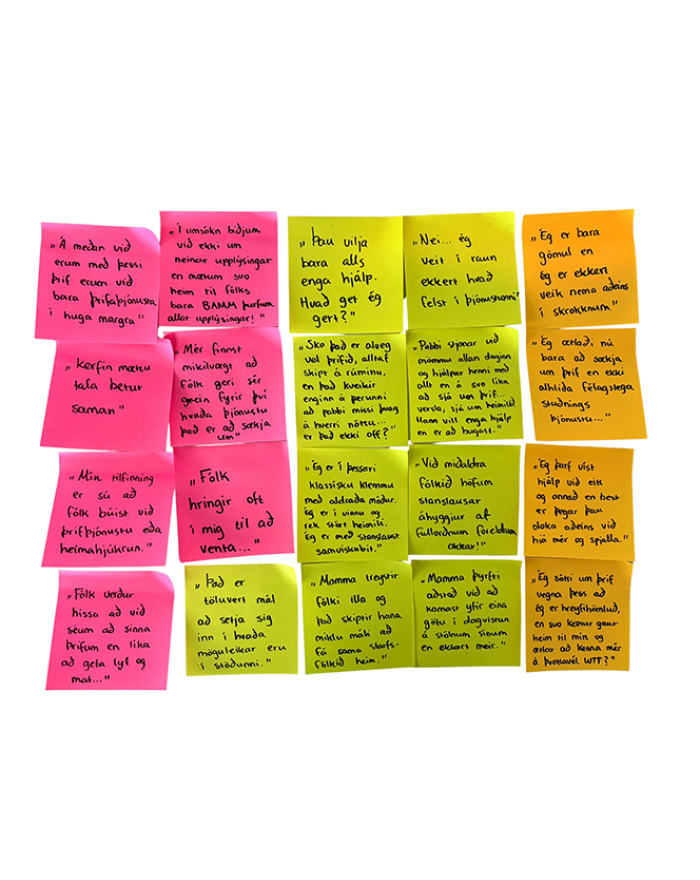
What's emerging
Several challenges are emerging from the interviews, including:
- confusion about what the service actually entails
- unclear information flow and disjointed systems
- manual, time-consuming processes
- potential gaps when transferring information between parties
- service users lacking clarity on where their cases stand
- and inconsistent internal practices
These findings are preliminary, however—we still need to analyze them thoroughly and compare them against other data and additional interviews.
Conversations with service users and immediate family
We have also started interviewing service users and their immediate family members. This diverse group has varying needs and different reasons for using the services, so reaching certain members requires extra time and effort.
Interviews will continue over the coming weeks. If you know someone who'd like to share their experience, please reach out at thjonustuhonnun@reykjavik.is 🧡
Post-it notes and Miro energy
Our service design methodology begins with a discovery phase. During this stage, we embrace all kinds of information related to the challenge at hand. This approach provides insights we might otherwise miss before narrowing our focus.
Right now, we are:
- interviewing service users and staff
- reviewing existing data
- consulting with other institutions and municipalities
- exploring solutions from other cities
- mapping our insights in Miro and on the wall with Post-it notes
While the process can get a little messy at times, this step is essential to ensure we solve the right problem when designing the service itself.
Anyone interested can learn more about this process in our toolbox. The toolbox covers the various phases of service design and provides access to canvases and other tools.
Thanks for reading—see you back here next Friday!
Coffee at North Center
March 6, 2026th
This week has been all about launching service user interviews and deepening our understanding of how the process actually works, both from the staff's perspective and those who use the services.
This week's tasks:
- Talked with home care services staff
- Interviewed geriatric affairs phone advisor
- Analyzed data
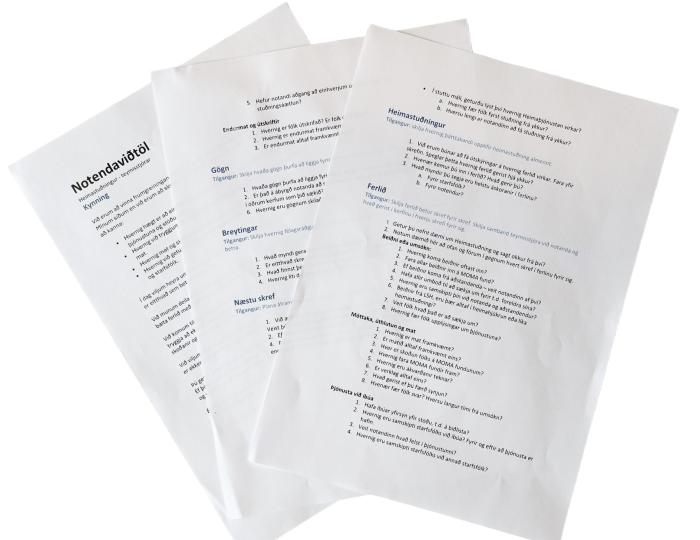
Talked with home care services staff
Our first interviews this week were with service staff, including home support team leaders. These conversations gave us better insight into:
- how they work day to day
- what processes and systems they rely on
- what challenges and opportunities they see in the current application and assessment process
We also watched them work in the systems they use, which gave us deeper understanding than interviews alone could provide. Seeing the flow in real time helped us understand where bottlenecks occur in the process.
Interviewed geriatric affairs phone advisor
We also had a very useful conversation with a geriatric affairs phone advisor. She gave us a clear picture of:
- the main questions that come in
- what information is unclear for service users
- what support people need before they decide to apply
- what parts of the process people find especially hard to understand
This insight is valuable since phone advisors are often people's first point of contact with the service.
Analyzed data
We're analyzing all these interviews as we go using Miro. There we're collecting:
- pain points
- opportunities
- the process as it is today...
- ...and how it could be better!
Next on our agenda is mapping the process and developing suggestions for improved and more efficient solutions.
Would you like to participate in an interview?
We're still looking for service users and/or immediate family who have:
- recently applied for home support
- are considering applying and want to share what's holding them back
The goal is to get a broad overview of people's experiences, both those who have entered the system and those still at square one.
We look forward to continuing to process this data and sharing project progress with you in our next blog post.

Problems, problems, problems…
Feb. 27, 2026
This week, we focused primarily on mapping the project, understanding its scope better, and identifying the challenges we need to solve.
This step has been both important and highly insightful — especially to ensure we have the correct focus from the beginning.
Service design follows specific steps, and we're currently at this stage (see image of the process).
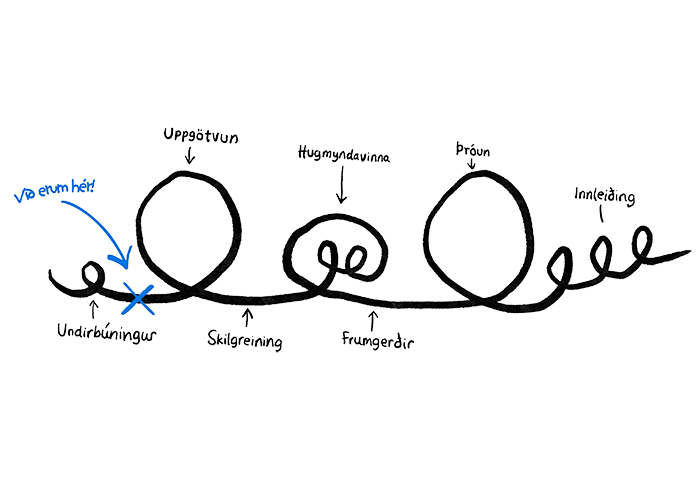
Core of the challenge
Right now, users — both older adults and their immediate family — struggle because they don't have a clear overview of the process, the service, or the status of their cases. The main issues we see are:
- The application form on My Pages is too open-ended, which leads to incomplete applications.
- Too many applications unnecessarily go to meetings, which increases the workload on staff.
- Work practices within home care services aren't standardized, for example in assessments and information sharing.
- Staff don't have a complete overview and must spend a lot of time gathering information that should be easily available.
These issues form the foundation for our upcoming work.
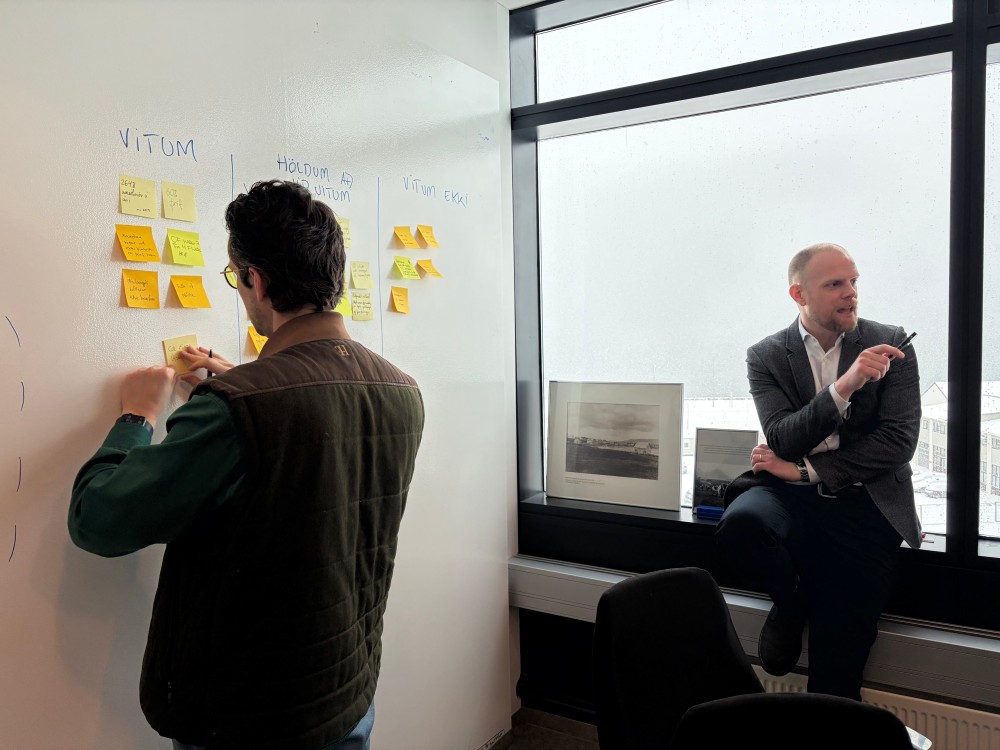
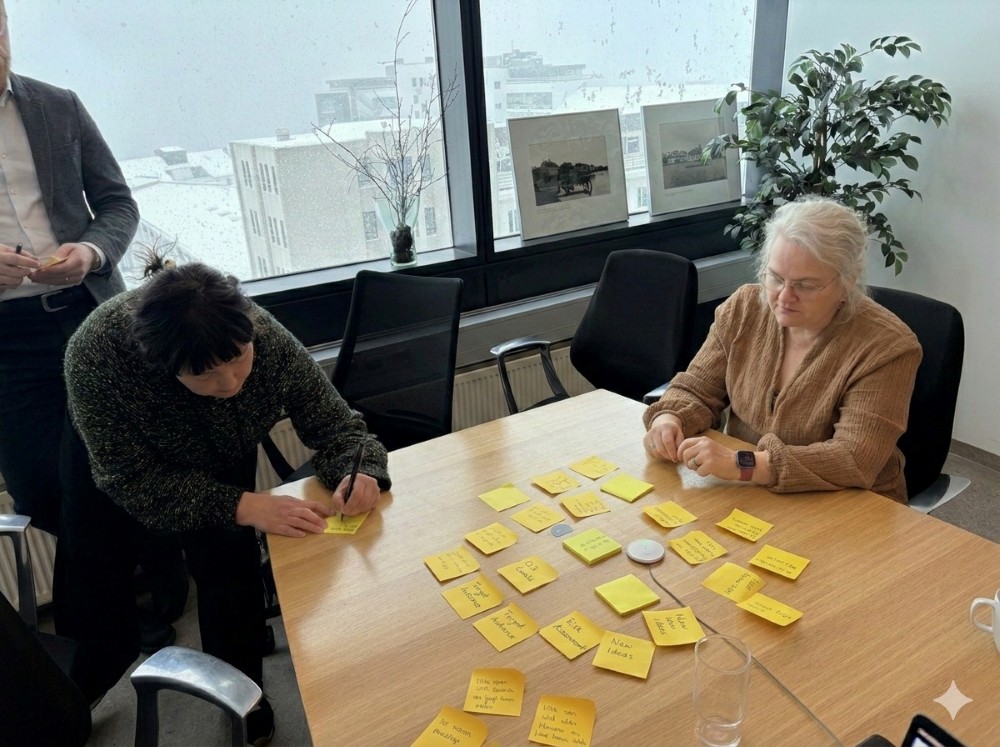
Workshop with owner group
We held a workshop with the owner group (owners are the people responsible for the service) where we went through two key components:
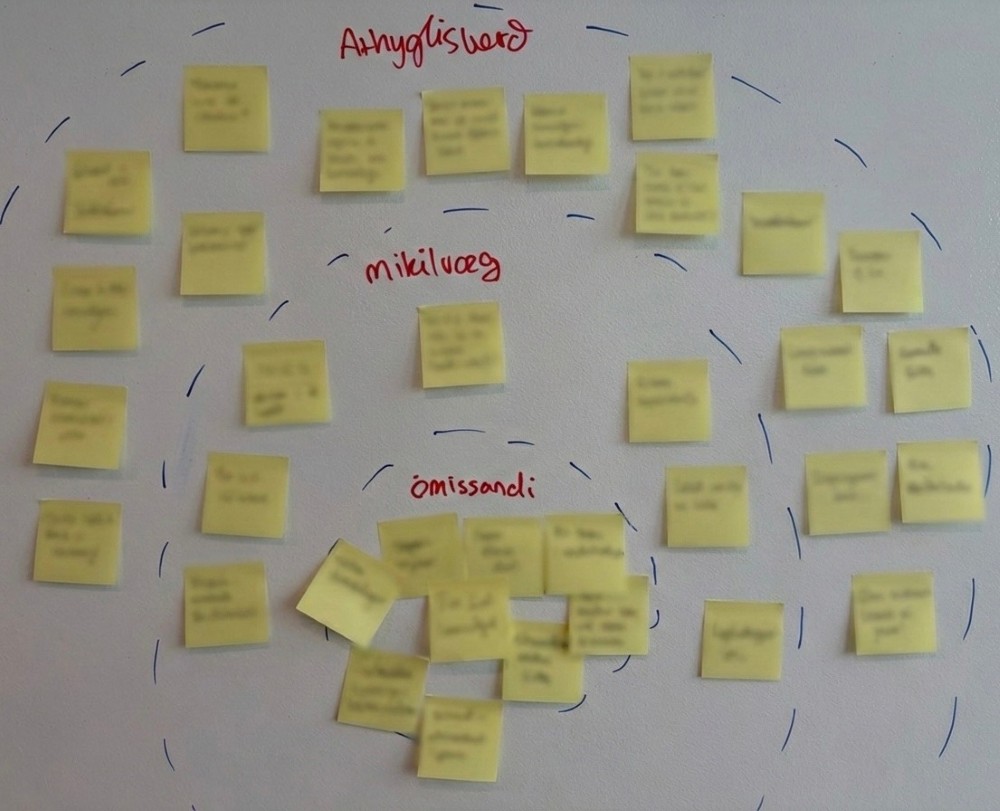
- Stakeholder mapping: stakeholders are individuals or organizational units with direct or indirect interest in the service.
- Knowledge mapping: what we know, what we think we know, and what we don't know.
This work helped us identify where the main gaps are and what information we specifically need to gather from the right users — both service users and staff.
We're now using these results to develop questionnaires for user interviews, where we've gained a clearer picture of what needs to be investigated and why.
Data from the service center
We've also started looking at data in collaboration with Reykjavík City's service center, particularly regarding phone calls related to the service. This data helps us see:
- What are people looking for?
- What questions are most common?
- Where uncertainty in the service process lies?
This will be useful in both analysis and design later.
We're looking for participants
We're now recruiting people for user interviews and have posted the following call to reach the right group:
Have you recently applied for home support services from Reykjavík City?
Whether you're a family member or service user, we're looking for people who have recently gone through the application process — please send us a message at thjonustuhonnun@reykjavik.is and we'll schedule time for a conversation.
The goal is to get diverse perspectives from people with real experience of the process.
We look forward to continuing to share the process and lessons learned with you in the coming weeks!
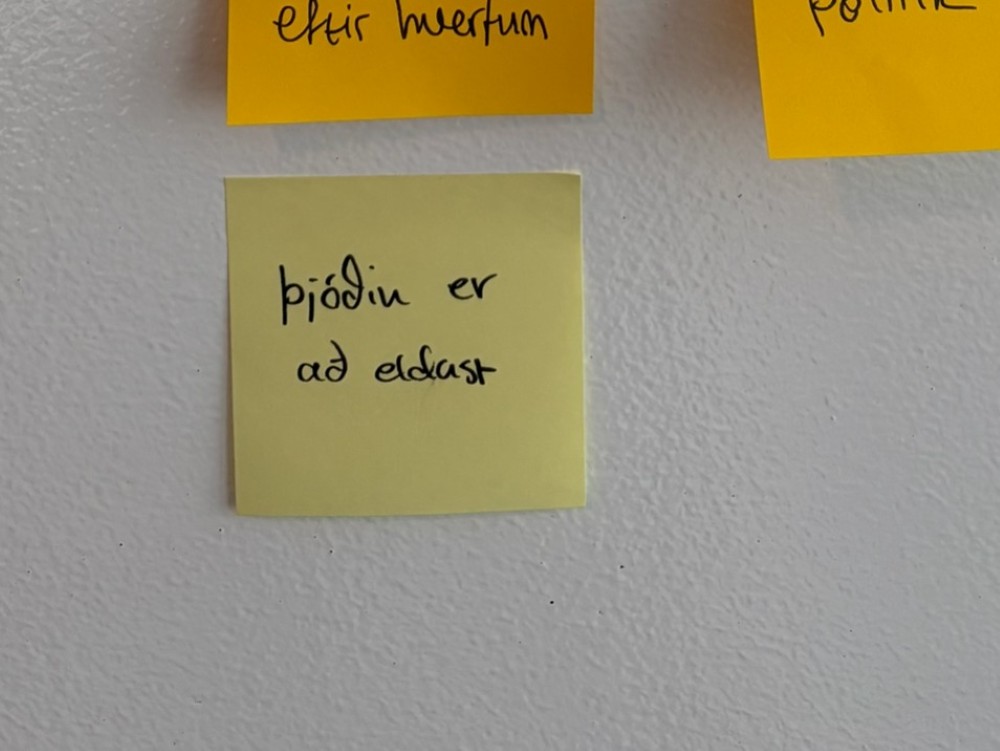
Images from the service design workshop
This Month's Focus: Seniors
Feb. 20, 2026
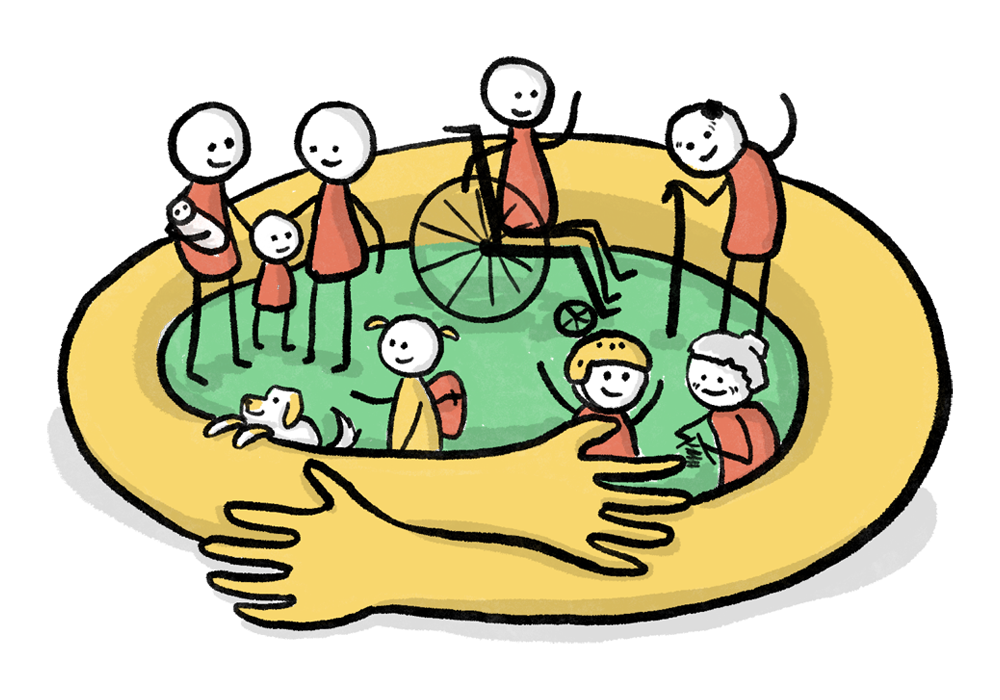
Welcome to our first Friday service design blog!
Over the coming weeks, we'll take a deep dive into services and digital solutions for older adults in Reykjavík. First on our agenda is looking at home support and exploring how we can make services better for residents and their immediate family.
We're just getting started and still asking questions, analyzing needs and creating a shared understanding of what really needs to change. Instead of waiting until everything is finished, we want you to follow along with our process from day one.
Why a blog?
Because it's so fun! We want to start conversations, show you how we work, share what we learn and discuss the challenges we face. When it comes
to
services for older adults, there's a lot at stake. Services must be clear, accessible, and built around the real needs of the people they serve. In discussions about digitalization, the voices of those affected sometimes get lost.
What can you expect?
- insight into the work behind the scenes
- conversations with residents and their immediate family
- what works well (and maybe what doesn't work so well)
- ideas and testing
- maybe jokes and humor, who knows!
All of this is part of creating services that are human, clear and simple. Services that respect the basic rights, needs and wishes of older adults.

Follow along on Fridays
We'll post new updates on Fridays throughout the project. If you're interested in services, geriatric affairs, digital solutions or just how public services are designed, you're in the right place. All suggestions are welcome. You can reach us at thjonustuhonnun@reykjavik.is.
We look forward to taking you along on this journey.
Your friends in service design 💛